
Planning for open a sushi bar
A precise work counter, a cold chain and consistent suppliers. The product and food safety guide the project.
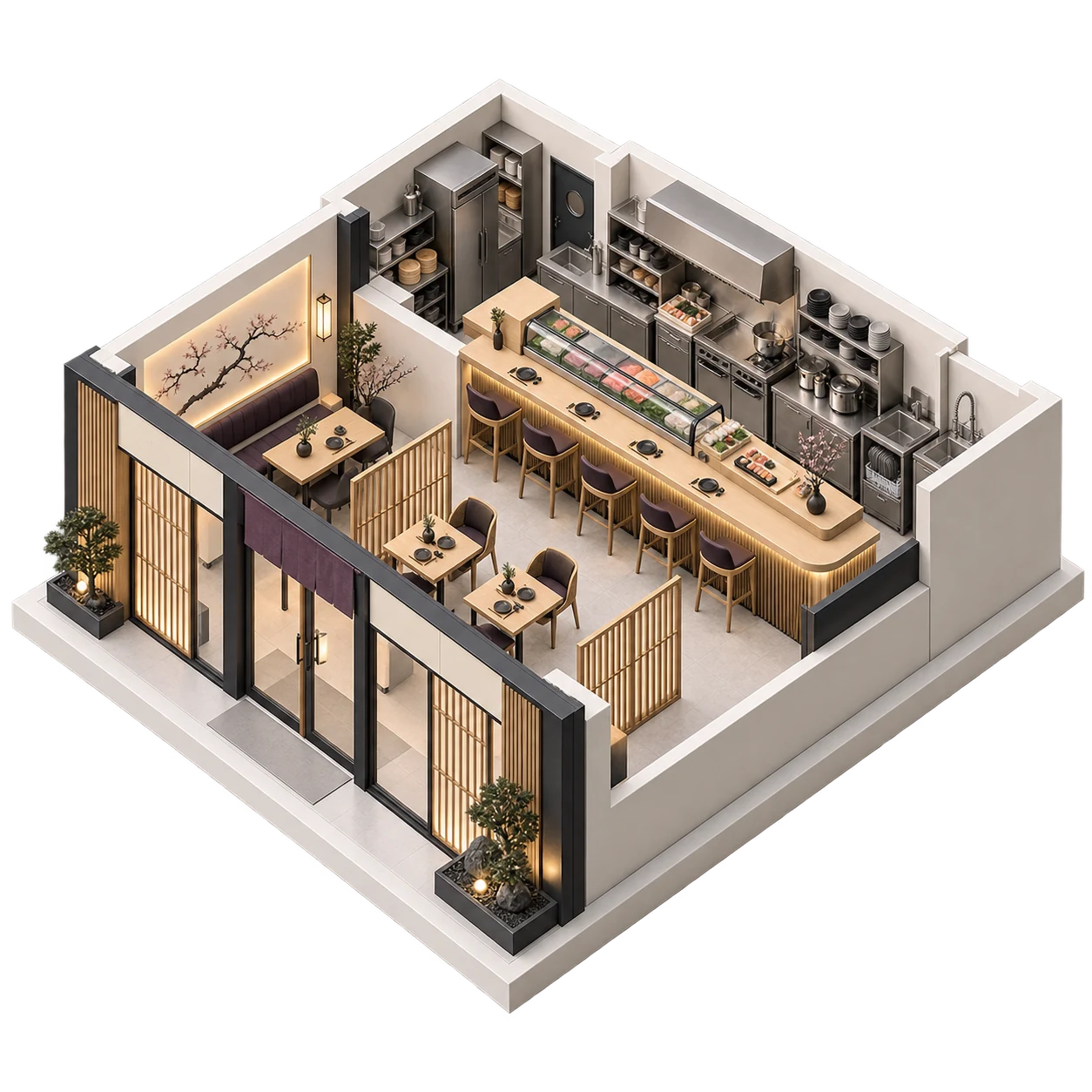
What the estimate includes
On-site sushi preparation, with counter service and a compact dining area.
| Item | Estimated range |
|---|---|
| Construction and adaptations | R$71,250 – R$142,500 |
| Equipment and installation | R$65,000 – R$120,000 |
| Furniture and in-space communication | R$30,000 – R$56,250 |
| Technical projects and specialists | R$13,500 – R$26,250 |
| Documentation and compliance services | R$1,500 – R$4,500 |
| Preparation and launch | R$7,000 – R$14,000 |
| Initial stock and consumable utensils | R$6,500 – R$11,000 |
| Implementation contingency | R$23,370 – R$44,940 |
| Foodelopers fees | R$36,900 – R$36,900 |
| Reserve for the property deposit | R$15,000 – R$15,000 |
| Operating reserve | R$87,000 – R$87,000 |
| Scenario total | R$357,000 – R$558,000 |
Includes 12% contingency on implementation, 3 months of coordination, and a reserve for entering the property equivalent to 3 rents. This reserve is a cash-flow assumption, not a legal requirement. Property purchase and acquisition of the premises are not included in the initial scenario. View full methodology
The business needs to sustain itself.
This is an exercise with editable assumptions. It does not represent proven demand or a guaranteed return.
| Monthly fixed expenses | R$29,000 |
|---|---|
| Average ticket | R$72 |
| Variable costs as a percentage of revenue | 55% |
| Monthly break-even revenue | R$64,444 |
| Orders per day to break even | 35 · 26 days per month |
Equipment that deserves attention
- Suitable refrigeration and display for the ingredients.
- Preparation and storage counters, and rice organization.
- Washing area and kitchen support for the menu’s hot items.
Request three comparable proposals including model, capacity, installation, freight, warranty, and support. Confirm power, gas, access, and dimensions with the project specialists before buying. Consult local suppliers
Decisions come before construction.
How will the ingredients be received?
Define purchasing, receiving, storage and traceability criteria with the food specialist. The appearance of the counter does not replace these controls.
What will the menu mix be?
Combos, à la carte dishes and hot dishes change yield, waste and complexity. Test portions and record recipe costs.
How do you maintain consistency during peak times?
Simulate cutting, assembly, dispatch and washing. The team and preparation space must support the expected orders.
Before opening
- Check the feasibility of the address and activity before committing to the premises.
- Confirm health, fire-safety, and project requirements with qualified professionals.
- Validate suppliers and the storage chain.
- Prepare technical sheets and sanitation routines.
- Train staff in assembly, portioning and traceability.
- Test packaging and dispatch times.
Foodelopers coordinates the concept, brand, and implementation. Architecture, engineering, technical responsibility, and permits depend on the relevant professionals and authorities.
Create my first briefSources for further reading
- Sebrae — break-even point calculation
- Sebrae SC — working capital and finance
- JUCESC — feasibility consultation
- CBMSC — business regularization
- Anvisa — good practices for food services
Planning model updated in October 2026. The figures were defined by Foodelopers as initial scenarios and should be replaced with real proposals.